Flight Brief
- Since 22 April 2026, residents of England, Scotland and Wales can no longer use an EU pet passport to take a dog, cat or ferret into the EU.
- An Animal Health Certificate is now required, issued by an Official Veterinarian, and a new one is needed for every trip.
- The certificate is valid for 10 days for entry to the EU, then 6 months for onward travel within the EU and 6 months for re-entry to Great Britain.
- Pets must arrive in the EU through a designated travellers' point of entry. Not every private airport is one.
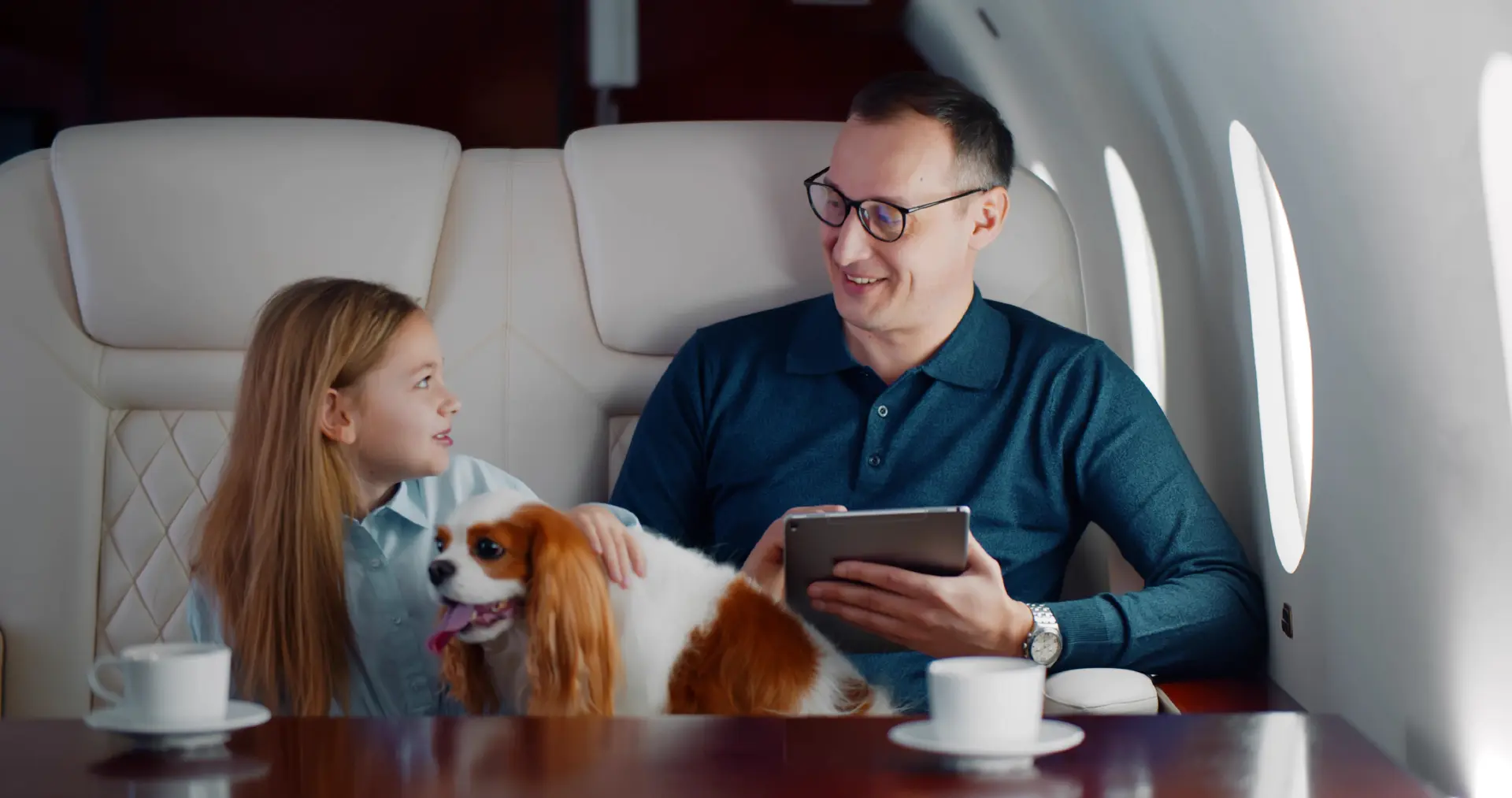
- On a private charter the pet travels in the cabin. There are no breed restrictions and no airline container rules.
Travelling with an animal? Tell us the species, breed and rough weight and we will check the routing works.
Start an EnquiryThe single reason most people charter privately with an animal has nothing to do with paperwork. It is that your pet travels in the cabin with you, for the whole flight. No hold, no cargo bay, no three hour check-in, and no separation at either end. For a nervous animal, an elderly one, or a breed that commercial carriers will not accept at all, that difference is the entire proposition.
The paperwork still has to be right, though, and it changed materially this spring. Here is what actually applies now, and the specific things worth knowing if you are flying private rather than scheduled.
What changed on 22 April 2026
Until this year, a good number of UK owners with property or family in Europe travelled on an EU pet passport, usually obtained from a vet in France or Spain during an earlier trip. That route is now closed. If you live in England, Scotland or Wales, an EU pet passport is no longer accepted for entry into the EU, and GOV.UK is explicit that using one may see your pet refused at the border. The change applies retroactively, so a passport issued years ago is no more valid than one issued last month.
It is not a UK decision. The underlying change is European, tying eligibility for a pet passport to the holder's habitual residence, which for GB residents is outside the EU. Northern Ireland residents are unaffected and can continue to use pet passports under existing arrangements.
In place of the passport, GB residents need an Animal Health Certificate, and the important word is every. A new certificate is required for each individual trip into the EU. There is no reusable document any more.
What you now need
The requirements themselves are unchanged. It is the document that carries them that is different. In order:
- A microchip, implanted before or at the same time as the rabies vaccination. If the order is reversed, the vaccination does not count and the animal has to be vaccinated again.
- A rabies vaccination, given no earlier than 12 weeks of age, with at least 21 full days between the first vaccination and travel. No wait is needed after a booster provided cover has not lapsed.
- An Animal Health Certificate, issued by an Official Veterinarian, which is a vet holding a specific government authorisation. Not every practice has one, so this is worth checking before you need it rather than when you do.
- Tapeworm treatment, which applies to dogs only. Required for some destinations, and required again on the way home within a defined window before arrival back in Great Britain. Cats and ferrets are exempt.
The certificate is valid for ten days for entry into the EU. Once you are in, it covers onward travel between EU countries for six months, and re-entry to Great Britain for six months. Worth knowing, because a good deal of published advice still quotes four months, which is out of date.
Pet travel rules have changed twice in recent years and the detail moves. Everything here reflects GOV.UK guidance at the time of writing, but always confirm the current requirements at gov.uk/taking-your-pet-abroad and check the specific rules of your destination country, which can add requirements of their own.
The bit that catches private travellers out
Here is the requirement that almost never appears in general coverage, and it matters far more when you are flying privately than when you are not.
Pets entering the EU from a third country must arrive through a designated travellers' point of entry. Each member state publishes its own list, and it is shorter than you would expect. Large commercial airports are almost always on it. Smaller private aviation airfields, which are frequently the whole reason for chartering in the first place, often are not.
The airport that suits the flight and the airport that can legally accept the animal are not always the same airport.
This is a solvable problem, but only if it is raised at the point of enquiry rather than the day before departure. It may mean routing to a slightly different airfield, or arranging clearance in advance. It is the first thing we check when an enquiry mentions an animal, and it is the single most common reason a pet-carrying itinerary has to be adjusted.
The ten day window against charter lead times
Charter's great advantage is speed. A flight arranged this afternoon for tomorrow morning is entirely normal. Pet paperwork does not move at that pace.
The certificate has to be issued within ten days of entering the EU, which sounds generous until you try to get an Official Veterinarian appointment at short notice in August. The practical answer is to decouple the two: if you know you are likely to travel, book the vet appointment as soon as the window opens and let the flight be the flexible part. The certificate covers you for six months of onward travel and return, so it is rarely wasted.
We Will Check the Routing First
Not every airport can legally accept a pet arriving from outside the EU, and operator policies vary. We confirm both before proposing an aircraft, not after.
Why the cabin makes the difference
Set the documents aside for a moment, because they are the same either way. What changes on a private charter is the experience.
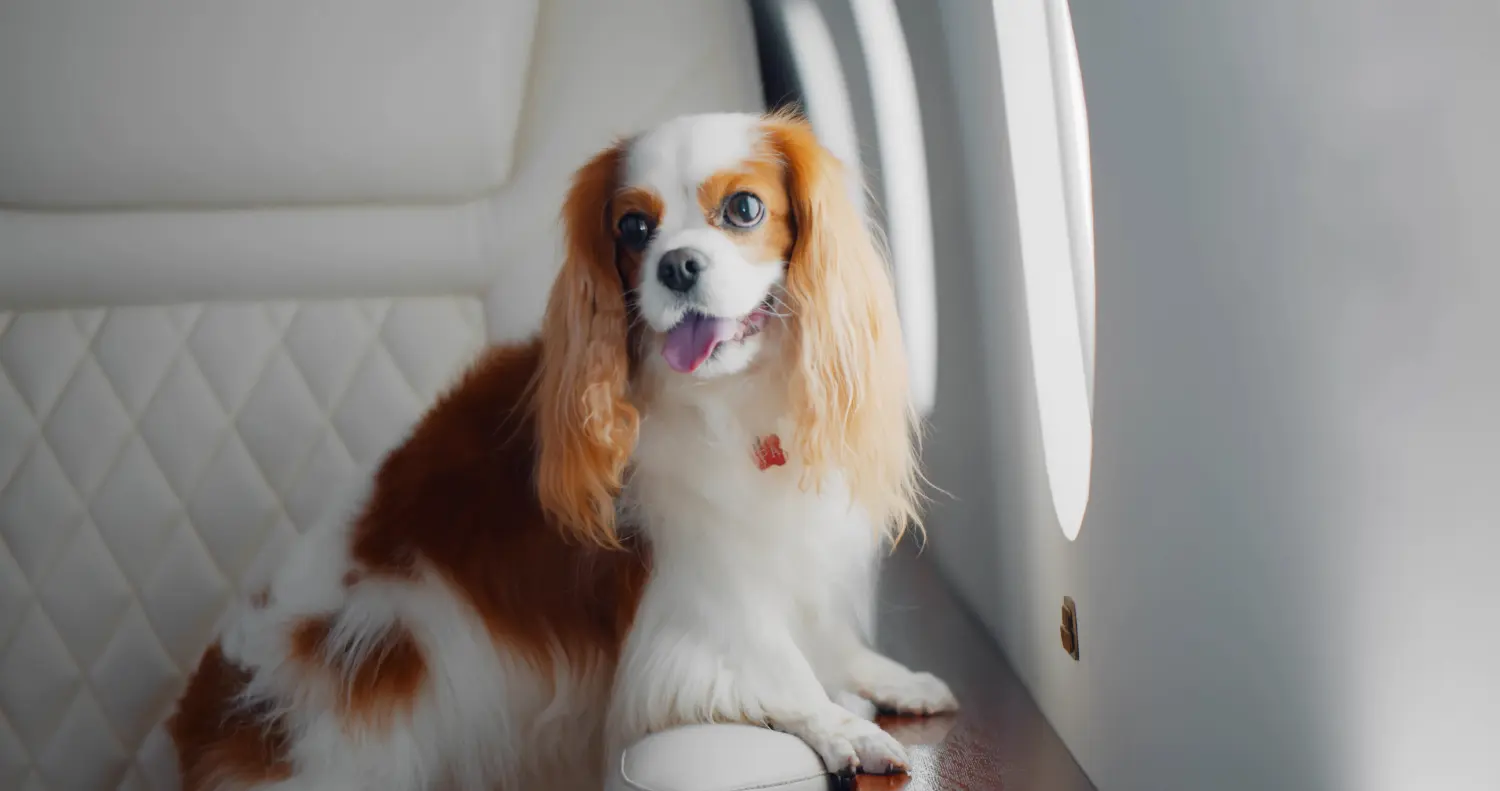
- No hold. The animal travels in the cabin with you. For a dog that usually means loose on the floor or on a bed rather than confined for the duration. Cats normally stay in a carrier, but it sits on the seat beside you rather than in a cargo bay.
- No breed restrictions. Commercial carriers restrict or refuse flat-faced breeds on welfare grounds in the hold, which affects bulldogs, pugs and boxers, and Persian and Himalayan cats. That constraint does not arise when the animal is in a pressurised, temperature-controlled cabin beside you.
- No container rules. Airline crate specifications and weight limits do not apply.
- Minimal ground time. Departure from a private terminal rather than a cargo acceptance desk. From our home base at London Farnborough, typically fifteen minutes from car to cabin instead of several hours, and where the airport permits it the car can meet the aircraft on the ramp.
- No separation. For an anxious or elderly animal this is usually the whole point.
Individual operators set their own policies on animals, and a small number do not accept them. As an independent broker we are not tied to any one fleet, so we simply source from those that do rather than asking you to work around a restriction. That is a question we resolve before an aircraft is proposed, not after.
Coming home
The return leg trips people up more often than the outbound one, largely because the outbound has had all the attention.
If you are travelling with a dog, tapeworm treatment has to be administered by a vet within a specific window before arrival back in Great Britain, and recorded on the certificate at the time. Too early does not count and neither does too late, and it must be done by a vet in the country you are leaving. Getting that appointment in a foreign town on a Sunday is not a situation to discover you are in. Cat and ferret owners can skip this step entirely.
Your pet's rabies vaccination also has to remain valid for the whole trip, not just the departure. If it expires while you are away, the certificate expires with it.
When you enquire, say at the outset that an animal is travelling, and give the species, breed and rough weight. That is enough for us to confirm the operator accepts animals, check that both airports work for the routing, and flag anything about the paperwork timeline that looks tight. It takes a few minutes at the enquiry stage and removes almost every way this goes wrong. We have been arranging charter since 1990 and answer 24 hours a day, so a question at an awkward hour is never a problem.
In short
The regulations got more tedious in April, not more difficult. Every trip now needs its own certificate, the certificate needs an Official Veterinarian, and the vet appointment is the part that requires planning rather than the flight.
What has not changed is the reason people do this. Your pet travels with you, in the cabin, and arrives in the same condition you did. And where the destination has no runway within useful reach, a helicopter leg can carry the animal the final stretch just as comfortably, which we arrange as part of the same booking.