Flight Brief
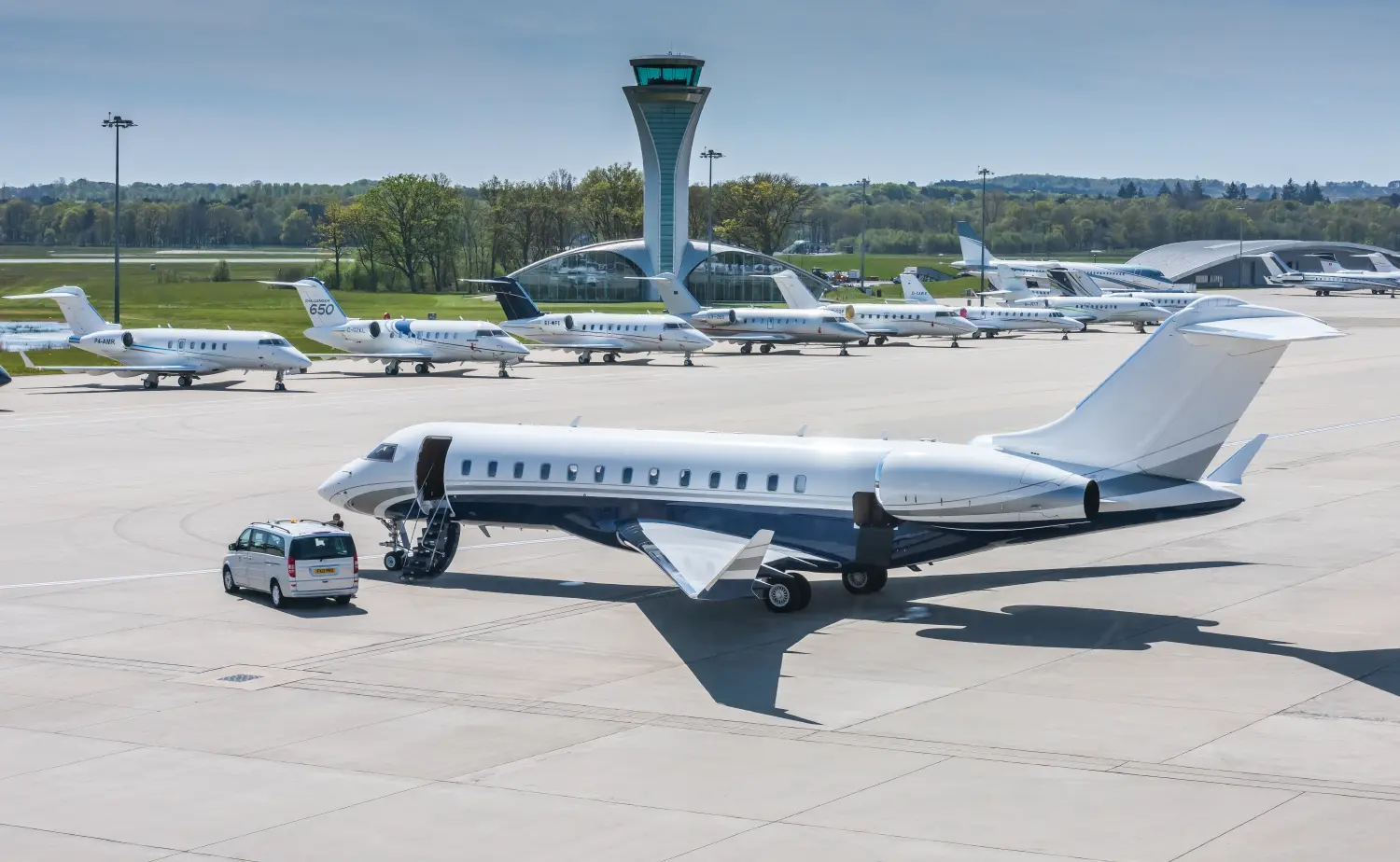
- Private jets fall into four broad classes: light, midsize and super-midsize, heavy, and ultra-long-range.
- Range and luggage volume decide the aircraft more often than seat count does.
- A light jet seats four to seven and suits sectors of two to three and a half hours. An ultra-long-range jet seats twelve to nineteen and can fly non-stop intercontinentally.
- Smaller aircraft can use shorter runways, which often means an airport closer to your destination.
- Helicopters and VIP airliners sit either side of the jet classes and are frequently the right answer.
Not sure which class fits? Tell us the trip and we will work backwards to the right aircraft.
Start an EnquiryMost people approach this question by counting passengers. It is a reasonable starting point and it is almost never what settles the matter. We have put parties of four on heavy jets and parties of nine on midsize aircraft, and in both cases the decision came down to something other than seats.
The four things that usually decide it are how far you are flying, what you are carrying, which airports you want to use, and how much of the journey you need to spend working or resting. Here is how the classes compare against those.
The jet classes
VLJ, Light Jet and Super Light Jet
Four to seven seats, typically up to about 1,500 nautical miles (approximately 2–3.5 hours). Aircraft such as the Citation Mustang and Hawker 400XP are typical examples.
The workhorse of short European charter. London to Nice, Dublin, Amsterdam or Edinburgh, comfortably. You cannot stand up in most light jets, and the baggage hold is more limited than on larger aircraft, so this class suits a small party travelling relatively light. What you gain is access: smaller jets can operate from shorter runways than larger aircraft, which can frequently put you at an airfield much closer to where you are actually going.
Midsize Jet and Super-Midsize Jet
Seven to ten seats, with ranges of up to approximately 4,000 nautical miles (approximately 5–8 hours). The Hawker 900XP, Praetor 600 and Challenger 3500 are typical examples.
One of the most versatile charter categories in both Europe and the Americas, offering a meaningful step up in cabin space, comfort and luggage capacity. Midsize jets are well suited to longer domestic and regional routes, while super-midsize aircraft extend the range for longer sectors, with some capable of transatlantic routes on favourable routings. With stand-up cabins on most super-midsize aircraft, generous luggage holds and space to work, this category is particularly well suited to longer trips and business travel.
Heavy Jet
Nine to sixteen seats, with ranges varying significantly by aircraft and configuration, typically up to around 4,500 nautical miles (approximately 6–9 hours). The Challenger 605, Falcon 900LX and Gulfstream G450 are typical examples.
A full galley, separate cabin zones, and enough space that a group can hold a private conversation at one end while others rest at the other. Many aircraft in this category are capable of transatlantic missions, although the exact capability depends on the aircraft, payload, routing and weather conditions. This is a popular class for boards, deal teams, touring parties and larger families, with baggage capacity suitable for considerably more than just a few suitcases.
Ultra-Long-Range Jet
Twelve to nineteen seats, with ranges of up to approximately 8,000 nautical miles (approximately 12–16 hours), depending on the aircraft. The Global 6000 and Gulfstream G650ER are typical examples.
Non-stop wherever you need to be. London to the US West Coast, the Gulf or Asia can be possible without a technical stop, depending on the aircraft, payload and conditions. On a tight schedule, the value is not simply comfort but the fuel stop you do not have to make, which can be the difference between arriving the same working day and losing one.
Worth knowing that range works differently in each direction on transatlantic routings. Westbound sectors generally face stronger headwinds than eastbound sectors, so an aircraft may comfortably operate New York to London non-stop but require additional fuel planning or a technical stop in the opposite direction. We have offices at both ends of that route, at London Farnborough and Teterboro in New Jersey, which means aircraft selection can be assessed against the actual operating conditions rather than relying solely on published range figures.
Published range assumes ideal conditions. A full passenger load, strong headwinds, high temperatures or a short runway all reduce it, sometimes considerably. Westbound transatlantic sectors face headwinds that eastbound ones do not, which is why an aircraft can make New York to London non-stop and need a stop coming back. We check the actual routing against the actual load rather than the brochure figure.
Either side of the jets
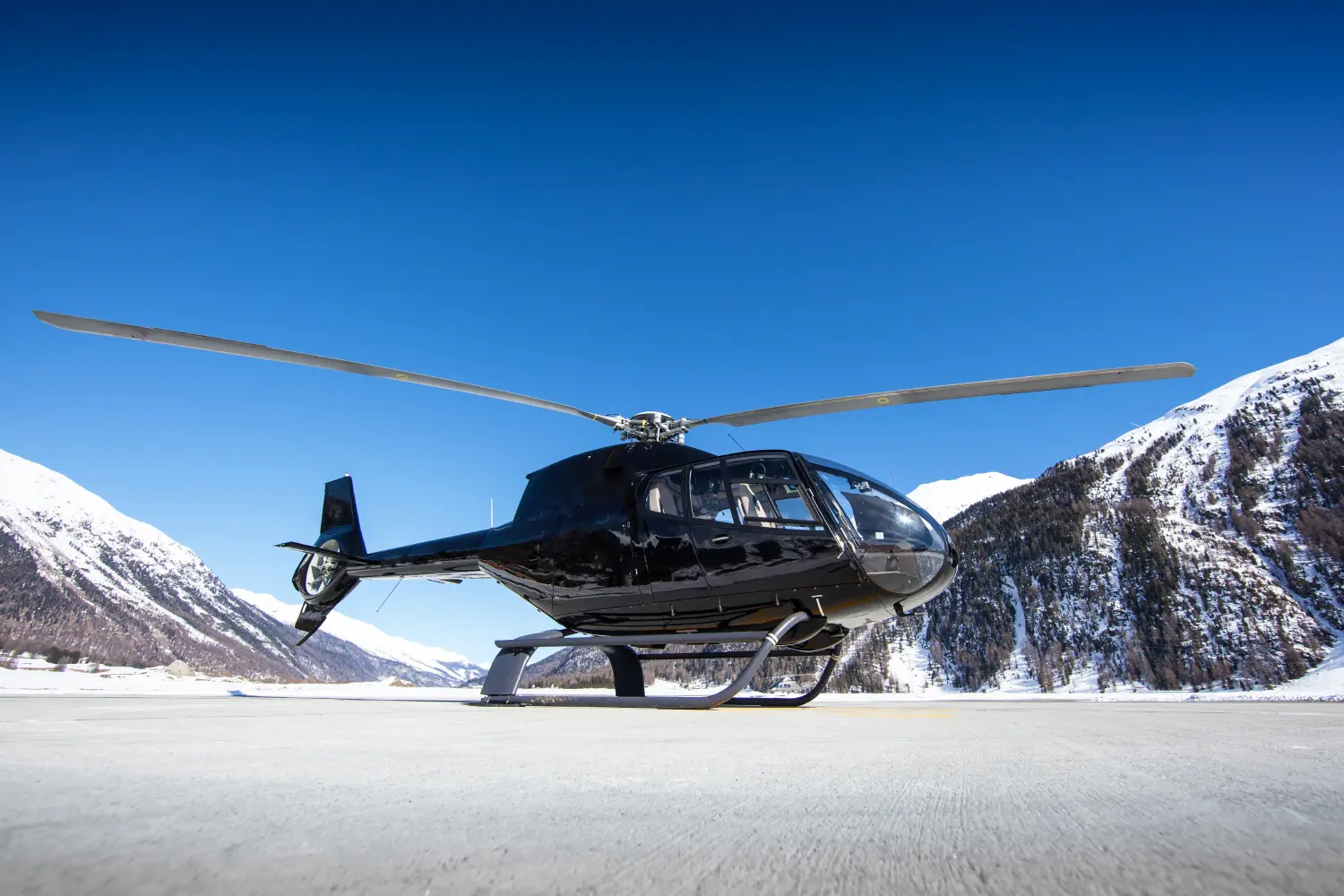
Helicopters
Three to twelve seats, typically up to 500 nautical miles. Not a substitute for a jet but frequently the piece that makes an itinerary work at all.
A helicopter goes where no runway exists: a festival site, a race meeting, an estate, a superyacht, a rooftop. It also connects central London to Farnborough in about fifteen minutes against sixty to ninety by road, airside to airside where the airport permits. A great many of the itineraries we arrange are a helicopter leg and a jet leg working together.
VIP Airliners
Typically configured for around 20 to 50+ passengers, although capacity and range vary significantly by aircraft and interior configuration. Aircraft such as the Airbus ACJ, Boeing Business Jet (BBJ) and Embraer Lineage 1000 are typical examples.
Essentially a private airliner, combining the space and long-range capability of a commercial aircraft with a bespoke private interior. Multiple cabin zones can include bedrooms, lounges, dining areas, showers and meeting spaces, depending on the configuration, providing considerably more space than even the largest business jets. Ideal for larger families, corporate groups, sports teams, touring parties and VVIP travel where privacy, comfort and flexibility matter more than simply getting from A to B. On long-haul routes, VIP airliners can offer a genuine flying residence, with substantial baggage and equipment capacity subject to the aircraft's payload and range limitations.
Tell Us the Trip, Not the Aircraft
We are an independent broker, so we have no reason to steer you towards a particular fleet. We will price more than one option and tell you which we would choose, including when the smaller one is the right answer.
What actually decides it
Luggage, more often than you would expect
Business jets have modest holds. Ski equipment, golf clubs, camera kit, instruments and medical equipment all take far more volume than the passenger count implies, and hold capacity is the single most common reason a party ends up on a larger aircraft than the seats required. Tell your broker what you are carrying, with rough weights, at the point of enquiry rather than at the aircraft steps.
Which airport you can use
A smaller aircraft or an aircraft with superior short-field performance that can land twenty minutes from your destination frequently beats a larger one landing ninety minutes away. Runway length, opening hours and handling availability all vary, and the closest airport on a map is not always usable. This works in both directions, so it is worth telling us where you are ultimately going rather than which airport you assume you need.
What you need to do on board
On a forty minute hop, cabin height is irrelevant. On a five hour sector where a team needs to work, or a nine hour one where they need to arrive able to perform, it is the whole question. Connectivity varies considerably between aircraft of the same class, so if the party must work in flight, say so early because it can change which specific aircraft we recommend.
Whether the aircraft has to position
Charter aircraft are not waiting at your departure airport. If the nearest suitable aircraft is two hours away, you pay for it to reach you. This is why a slightly larger aircraft based nearby sometimes costs less than a smaller one that has to fly in, and why a same-day return is often better value than two one-way sectors.
As an independent broker we are not tied to any one fleet, so we have no reason to steer you towards a particular aircraft. We will usually price more than one option and tell you which we would choose, including when the smaller and cheaper aircraft is genuinely the right answer. Every operator we propose has been independently vetted by Starflight before the aircraft is confirmed.
In short
Count the passengers, then ask the four questions that actually matter: how far, what are you carrying, which airports, and what do you need to do on board. The answers will usually point at one class, and where they point at two, the difference is worth discussing rather than guessing.
We have been matching clients to aircraft since 1990, across everything from a single executive to a full touring party with freight. Tell us the trip rather than the aircraft, and we will work backwards to the right answer.